
Personality psychology: a complete introduction
When people hear "personality psychology", some think of the pop-psychology quizzes that fill social media. In this article I cover personality psychology properly, as an educational introduction. Like every page on this site, it is updated over time and will keep growing.
Our unique personality makes us who we are, and it shapes everything from our relationships to the way we live. Here we look at what personality is, the theories about how it develops, how personality is assessed, and what it means to have a personality disorder.
Personality psychology is the branch of psychology that studies personality and how it varies between people. Its main areas of focus are:
- building a coherent picture of a person and their main psychological processes;
- studying individual psychological differences;
- studying human nature and the psychological similarities between people.
"Personality" is a dynamic, organised set of characteristics that uniquely influences a person's environment, thinking, emotions, motivation and behaviour across different situations. The word comes from the Latin persona, meaning "mask".
Personality refers to patterns of thoughts, feelings, social adjustments and behaviours that a person shows consistently over time, and that strongly influence their expectations, self-perception, values and attitudes. Personality also helps predict how people respond to others, to problems and to stress.
Gordon Allport (1937) described two main ways to study personality: nomothetic and idiographic. Nomothetic psychology looks for general laws that apply to many people, such as the principle of self-actualisation or the trait of extraversion. Idiographic psychology tries to understand the unique aspects of a particular person.
The study of personality has a long and varied history in psychology, with many theoretical traditions. The major ones include the dispositional (trait), psychodynamic, humanistic, biological, behaviourist, evolutionary and social learning perspectives.
Many researchers and psychologists do not identify with a single perspective and instead take an eclectic approach.
Why personality psychology matters
Personality psychologists study how personality differs from one person to another, and how people can also be similar. Some clinicians in this area assess, diagnose and treat personality disorders.
Understanding personality helps psychologists predict how people are likely to respond to particular situations and what they tend to prefer. To understand how researchers study personality, it helps to know some of the most influential theories.
The foundations of personality psychology
What makes you who you are? Many factors shape your personality, including genetics, your upbringing and your life experiences.
Many people think that what makes you unique is a distinctive pattern of thoughts, feelings and behaviours that together form your personality. Although there is no single agreed definition, personality is often thought of as something that comes from within a person and stays fairly stable throughout life.
Personality includes all the thoughts, behaviour patterns and social attitudes that influence how we see ourselves and what we believe about other people and the world around us.
Many ideas developed by past personality theorists and modern specialists come from their basic philosophical assumptions. The study of personality is not a purely empirical discipline; it brings together elements of art, science and philosophy. Theorists disagree on five basic philosophical questions:
Freedom versus determinism
Do people control their own behaviour and understand the motives behind it, or is their behaviour determined by forces outside their control? Depending on the theory, behaviour is explained as unconscious, environmental or biological.
Heredity versus environment (nature versus nurture)
Is personality mainly determined by genetics and biology, or by environment and experience? Contemporary research suggests that most personality traits reflect the combined influence of genes and environment. One of the leaders in this area is C. Robert Cloninger, who pioneered the temperament and character model.
Uniqueness versus universality
How unique is each person, and how much do we share as humans? Gordon Allport, Abraham Maslow and Carl Rogers all emphasised the uniqueness of individuals. Behaviourists and cognitive theorists, by contrast, emphasise universal principles such as reinforcement and self-efficacy.
Active versus reactive
Do people act mainly through their own initiative (active) or in response to outside stimuli (reactive)? Traditional behaviourists usually believed that people are passively shaped by their environment, while humanistic and cognitive theorists believe people play a more active role. Most modern theorists agree that both matter: overall behaviour is shaped mainly by traits, while situational factors are the main predictors of behaviour in the short term.
Optimistic versus pessimistic
Theories differ on whether people can play an important part in changing their own personality. Theories that put a lot of weight on learning are often more optimistic than those that do not.
Theories of personality
Many theories have been put forward to explain personality. Some focus on how personality develops, while others focus on individual differences. The table below lists some of the best-known theorists, and we look at the main theories in turn.
| Theorist | Approach | Key idea |
|---|---|---|
| Sigmund Freud | Psychoanalytic | Id, ego and superego; psychosexual stages |
| Erik Erikson | Psychosocial development | Eight life stages, each with a developmental crisis |
| Karen Horney | Psychoanalytic / feminist | Basic anxiety; moving towards, away from or against people |
| Gordon Allport | Trait | Cardinal, central and secondary traits |
| Costa and McCrae | Trait | The Big Five personality dimensions |
| B. F. Skinner | Behavioural | Behaviour shaped by its consequences |
| Albert Bandura | Social-cognitive | Observational learning and self-efficacy |
| Abraham Maslow | Humanistic | Hierarchy of needs and self-actualisation |
| Carl Rogers | Humanistic | Person-centred therapy and the self |
Trait theories of personality
Trait theories are based on the idea that personality is made up of broad traits or dispositions. Different theories try to identify which traits are the core parts of personality, and how many basic traits there are.
The psychologist Gordon Allport was one of the first to describe personality in terms of individual traits. He proposed cardinal, central and secondary traits, and also described common traits shared by many people within a culture.
Central traits are the main characteristics that make up a person's personality. Cardinal traits are so dominant that a person becomes known mainly for them. Secondary traits appear only in certain situations.
The Big Five theory of personality
Today the "Big Five" is probably the most widely accepted theory of personality. It holds that personality is made up of five broad dimensions:
- Agreeableness
- Conscientiousness
- Extraversion
- Neuroticism
- Openness to experience
Each trait is a continuum, and each person sits somewhere along the range for every trait. For example, you might be high in extraversion, conscientiousness and agreeableness, but in the middle for openness and neuroticism.
A 2018 study analysing large Big Five datasets suggested that these traits cluster into four broad personality types: average, reserved, self-centred and role model. That brings us to theories about how personality develops.

Theories of personality development
Freud's theory of psychosexual development is one of the best-known theories of personality, and one of the most controversial. According to Freud, children's personalities develop through a series of stages. At each stage, libidinal energy (the drive behind much of human behaviour) is focused on a particular erogenous zone. Completing a stage successfully allows the person to move on to the next one. Problems at any stage can lead to fixations that affect personality in adulthood.
The psychologist Erik Erikson described eight psychosocial stages across the lifespan. In his theory, each stage plays an important part in the development of personality and psychological skills. At each stage, the person faces a developmental crisis that acts as a turning point, and resolving each stage successfully leads to healthy personality development.
While Freud believed that personality is formed early in childhood, Erikson believed that personality continues to develop throughout life. Erikson was also more interested in how social interaction shapes personality, and focused especially on the development of what he called ego identity.
Other major theories of personality include biological, behavioural, psychodynamic and humanistic theories.
How is personality assessed?
Psychologists use many kinds of personality tests to study and measure personality. One of the best known is the Myers-Briggs Type Indicator (MBTI), which is widely used in workplaces. However, its scientific support is limited, and its publisher states that it should not be used for hiring decisions.
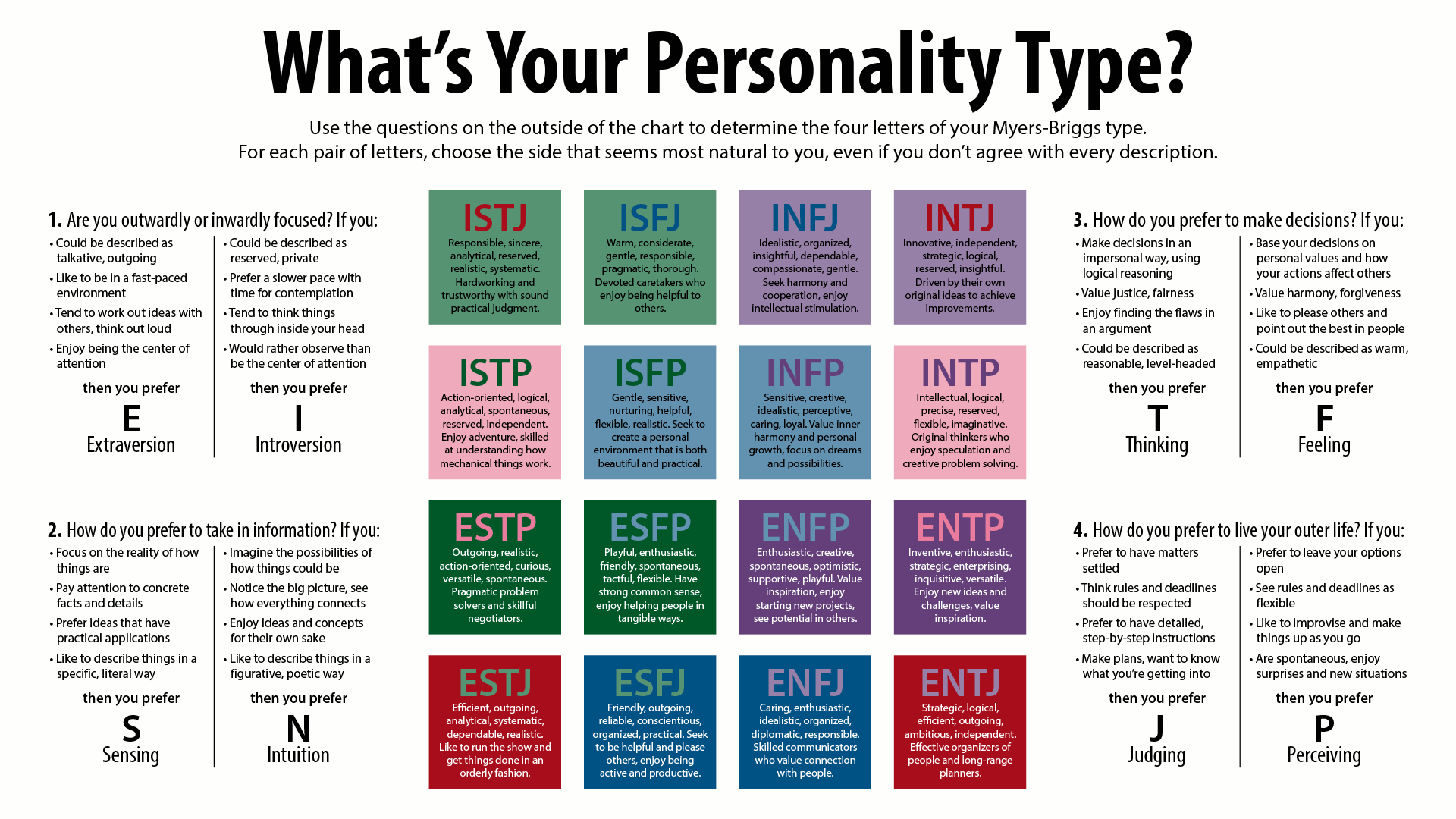
Other assessments help people learn more about different aspects of their personality, and some personality tests are used as screening and assessment tools to help diagnose personality disorders. A better understanding of your personality can help in many areas of life; for example, relationships with friends, family and colleagues may improve when you notice that you work well with others, or that you need time alone.
You have probably come across online personality quizzes, such as ones that tell you whether you are an introvert or an extravert. Some claim to reveal "the real you", while others are clearly just for fun.
Treat online personality assessments with care. Informal tools can be fun and may offer some insight into your preferences and traits, but only tests given by trained, qualified professionals should be used as formal assessments or for diagnosis.
Personality disorders
Personality disorders are long-lasting, pervasive patterns that can seriously affect a person's thoughts, behaviour and relationships.
The current Diagnostic and Statistical Manual of Mental Disorders (DSM-5) lists ten personality disorders, including antisocial, borderline, narcissistic and obsessive-compulsive personality disorder. You can read more in the article on personality disorders.
The US National Institute of Mental Health (NIMH) estimates that about 9.1% of US adults have at least one personality disorder. Receiving this diagnosis can be upsetting, but effective treatments exist. Working with a qualified mental health professional can help you understand the difficulties these disorders can cause and find ways to cope.
It is natural to feel afraid or worried about the future, but you do not have to face it alone. Trained professionals can help you take the next steps. Depending on the diagnosis, a clinician may recommend psychotherapy, skills training, medication or a combination.
Psychoanalytic theories of personality
Psychoanalytic theories explain human behaviour in terms of the interaction between different parts of the personality. Sigmund Freud founded this school of thought, and he drew on the physics of his day (thermodynamics) to coin the term psychodynamics.
Freud divided the human personality into three parts: the id, the ego and the superego. Central to his theory are the channelling and release of sexual (libidinal) and aggressive energies, which come from the drives of "Eros" (sex and self-preservation) and "Thanatos" (death and destruction). Freud's broad idea of sexuality included all kinds of pleasurable feelings experienced by the body.
Freud proposed five psychosexual stages of personality development. He believed that adult personality depends on early childhood experiences and is largely set by about age five. Fixations at an early stage, he argued, could show up later as adult personality traits.
Heinz Kohut built on Freud's ideas, including transference. He used narcissism as a model for how people develop their sense of self. Kohut had a major influence on the field by extending Freud's theory of narcissism and introducing what he called the "selfobject transferences" of mirroring and idealisation. In other words, children need to idealise and emotionally "merge" with the capability of admired figures such as parents or older siblings, and they need to have their worth mirrored back by these people. Such experiences allow them to learn self-soothing and the other skills needed to develop a healthy sense of self.
Karen Horney and feminist psychology
Another important figure in personality theory is Karen Horney, who is credited with helping to found "feminist psychology". She disagreed with Freud on several key points. One was that women's personality is not simply a function of "penis envy"; she argued that girls have their own distinct psychological life.
Horney described how harmful treatment in childhood, such as indifference or a lack of warmth from parents (which she called "basic evil"), can lead to "basic hostility" and "basic anxiety". She believed that people cope with this anxiety in one of three ways: moving towards people, moving away from people, or moving against people. These strategies give rise to different personality types and traits. She also wrote about the overvaluation of love and romantic partners.
Behavioural theories of personality
Behaviourists explain personality in terms of the effects that external stimuli have on behaviour. These approaches, known as behavioural or learning theories, were a radical shift away from Freudian philosophy. A core principle is a strong emphasis on scientific thinking and experimentation.
B. F. Skinner developed a model that emphasised the two-way interaction between the person, or "organism", and their environment. Skinner believed that children may behave badly because the behaviour earns attention, which acts as a reinforcer. For example, a child cries because crying has led to attention in the past. The crying is the response, and the attention is its reinforcing consequence. According to this theory, behaviour is shaped by processes such as operant conditioning. Skinner put forward a "three-term contingency" model that helped promote behaviour analysis based on stimulus, response and consequence. The key question is: under what conditions, or antecedent stimuli, does a person engage in a particular behaviour, or response, which in turn produces a particular consequence?
Richard Herrnstein extended this theory to account for attitudes and traits. An attitude develops when the strength of a response (the tendency to respond) becomes stable in the presence of a group of stimuli. Rather than describing traits in non-behavioural language, the strength of a response in a given situation accounts for the environmental part. Like most modern behaviourists, Herrnstein also believed that traits have a large genetic or biological component.
Ivan Pavlov was another major influence. He is well known for his classical conditioning experiments with dogs, which helped lay the foundations of behaviourism.
Social-cognitive theories of personality
In cognitive theories, behaviour is explained by our thoughts and beliefs about the world, especially about other people. Cognitive theories of personality emphasise cognitive processes such as thinking and judging.
The social learning theorist Albert Bandura proposed that memory and emotion work together with environmental influences.
Early examples of approaches to cognitive style were reviewed by Baron (1982). One example is attributional style theory, which deals with the different ways people explain events in their lives. It builds on the idea of locus of control, adding that we also need to consider whether people attribute events to stable or changeable causes, and to global or specific causes.
Humanistic theories of personality
Humanistic psychology emphasises that people have free will and that this plays an active part in how they behave. It therefore focuses on people's subjective experiences rather than on forces that determine behaviour. Abraham Maslow and Carl Rogers were leading figures in this approach, which drew on the "phenomenal field" theory of Combs and Snygg (1949). Rogers and Maslow were among a group of psychologists who worked together for a decade to produce the Journal of Humanistic Psychology, which focused on seeing people as whole persons rather than only as separate traits and processes.
Robert W. White wrote The Abnormal Personality, which became a standard text on abnormal psychology. He also studied the human drive towards positive goals such as competence and influence, to balance Freud's emphasis on the pathological side of personality development.
Maslow spent much of his time studying what he called "self-actualising people": those who are fulfilling themselves and doing the best they are capable of. He believed that everyone interested in growth moves towards self-actualising views (growth, happiness, satisfaction). He described four key dimensions of self-actualising people:
- Awareness: a lasting sense of enjoyment and awe in life. These people often had "peak experiences", which Maslow defined as an intensification of experience to the point of a loss or transcendence of self. In a peak experience, a person feels an expansion of self and senses unity and meaning in life. Intense focus on an activity, such as running a marathon, can bring about a peak experience.
- Reality and problem centredness: a tendency to focus on real "problems" in their surroundings.
- Acceptance and spontaneity: accepting their surroundings and what cannot be changed.
- Unhostile sense of humour and a democratic outlook: they do not enjoy jokes at other people's expense, and they have friends of all backgrounds and beliefs, with very close friendships.
Maslow and Rogers emphasised a view of the person as an active, creative, experiencing human being who lives in the present and responds subjectively to current perceptions, relationships and encounters. They disagreed with the darker, more pessimistic outlook of Freudian psychoanalysis, and saw humanistic theories as positive and optimistic, emphasising the tendency of human personality towards growth and self-actualisation. The developing self stays at the centre of its constantly changing world: a world that helps shape the self but does not necessarily limit it, because the self has the chance to mature through its encounters with the world.
Humanistic therapy usually relies on the client to share information about the past and its effect on the present, so the client guides the direction the therapist takes. This allows an individual approach to therapy. Rogers noticed that clients differ in how they respond to other people, and he tried to model a particular approach to therapy that emphasised reflective, or empathic, responses. This kind of response takes the client's point of view and reflects back their feelings and the context. An example of a reflective response would be: "It sounds as if you are feeling anxious about your upcoming marriage." This kind of response checks the therapist's understanding while encouraging the client to think more deeply and fully understand the feelings they have expressed.