
Types of personality disorders: a complete guide
What is personality?
Your personality is the way you think, feel, behave and relate to others. Once you are an adult, your personality usually does not change much. If you are a psychology student interested in this, you might explore personality psychology.
What are personality disorders?
Personality disorders are a group of mental health conditions. They involve long-term patterns of thinking and behaving that differ from what is considered usual in your culture. In other words, people with a personality disorder have unhealthy and inflexible ways of thinking and behaving. These patterns cause serious problems in relationships, work and social life, and make it hard to cope with everyday stress and problems.
Types of personality disorders
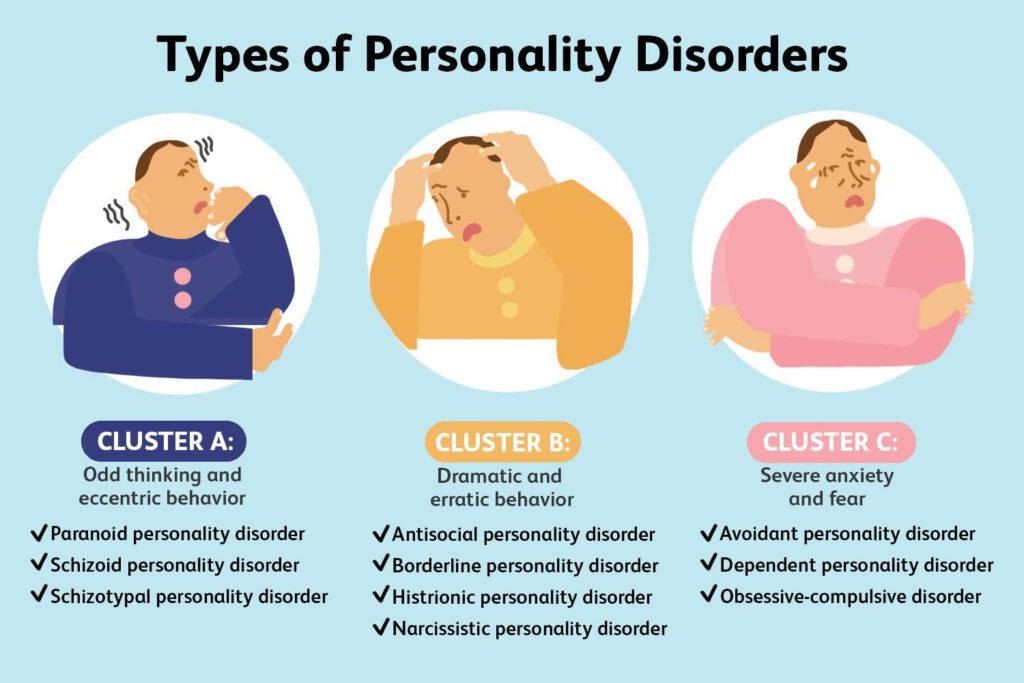
There are 10 types of personality disorder, grouped into three clusters. The types in each cluster share similar symptoms and features. The clusters and types are:
Cluster A personality disorders involve unusual and eccentric thinking or behaviour. They include:
Paranoid personality disorder
The person has paranoia (intense fear and distrust of others). They may believe others want to harm them.
Schizoid personality disorder
The person prefers to be alone and is not interested in forming relationships with others.
Schizotypal personality disorder
The person has unusual thoughts, behaviour and speech, and is uncomfortable with close relationships.
Cluster B personality disorders involve dramatic and emotional thinking or behaviour that can change constantly. They include:
Antisocial personality disorder
The person has a long-term pattern of manipulating, exploiting or violating the rights of others.
Borderline personality disorder
The person has great difficulty managing their emotions. This can make them impulsive and unsure of how they see themselves, and it can cause many problems in their relationships.
Histrionic personality disorder
The person is dramatic, has strong emotions and always seeks attention from others.
Narcissistic personality disorder
The person lacks empathy and wants to be admired. They believe they are better than others and deserve special treatment.
Cluster C personality disorders involve anxious and fearful thinking or behaviour. They include:
Avoidant personality disorder
The person is very shy and feels they are not as good as others. They often avoid people because they fear rejection.
Dependent personality disorder
The person depends too much on others and feels they need to be looked after. They may put up with being mistreated because they fear losing the relationship.
Obsessive-compulsive personality disorder
The person needs control and order. They are perfectionists and can be inflexible. Although some symptoms are similar, this is not the same as obsessive-compulsive disorder (OCD).
What causes personality disorders?
Personality disorders usually begin in the teenage years or early adulthood, and the exact cause is unknown. However, genes and childhood experiences such as abuse and trauma probably play a part.
What are the signs of a personality disorder?
The signs differ for each personality disorder, but each involves difficulties and uncertainty in how people see themselves. Personality disorders also cause problems in relationships with other people.
People with personality disorders may find it hard to recognise that they have a problem. Their way of thinking feels normal to them, and they may see other people as the problem. So they may not look for help when they need it, or they may look for help for a different reason, such as other mental health symptoms or problems at work or in relationships. Sometimes someone else, such as a family member or a social agency, asks them to get help.
How are personality disorders diagnosed?
A mental health professional can diagnose a personality disorder. To make a diagnosis, the clinician considers the person's symptoms, experiences and family medical history. A full medical examination may also be done to help rule out other causes of the symptoms.
Treatment of personality disorders
Psychotherapy is the main treatment for personality disorders. Medication may help with specific symptoms such as anxiety or mood swings, but people can improve with therapy.
Signs of personality disorders usually appear in the teenage years or early adulthood, continue into adulthood, and some become less noticeable in middle age. (Antisocial personality disorder is not diagnosed before the age of 18.)
Why do personality disorders develop?
Some experts believe that events in early childhood have a powerful influence on later behaviour. Others believe some people are genetically more likely to develop personality disorders. In some cases, the environment may trigger a personality disorder in someone who is genetically vulnerable.