
REBT: Albert Ellis's rational emotive therapy
REBT stands for rational emotive behaviour therapy. It was founded by Albert Ellis in the mid-1950s (around 1955) and is considered the first form of cognitive behavioural therapy. Here I explain what you need to know to understand this approach; if you read this page slowly and thoughtfully, you will have a good overview by the end. Two points: first, while researching REBT I noticed that many sources about it are somewhat biased and present it as the best form of psychotherapy. Second, REBT has a lot to it, and because I like to write all of this site's content myself, it takes time to cover everything, so please check back for updates.
The founder of REBT
REBT is a very directive, teacher-like approach. It moves quickly and the therapist takes a much more active, authoritative role than in psychoanalytic approaches. It is a serious approach; informally, you could say REBT can be uncomfortable!
Ellis first practised psychoanalysis, but he was dissatisfied with how slow and ineffective it was, and he gradually developed a new approach that focused on thinking as well as emotion and behaviour. In 1962 he published Reason and Emotion in Psychotherapy, which became one of the foundational texts of the cognitive therapies. Ellis pointed out that clients sometimes know the cause of their problem and their pain, yet therapy does nothing to change it, and sessions go on and on; he was strongly focused on effectiveness.
In psychoanalysis, emotion is at the heart of therapy, and Freud was among the first to put emotion at the centre of treatment. In the 1960s many therapists took up Ellis's ideas, but some criticised his approach as too rational and too little concerned with emotion, even though the "E" in its name stands for "emotive".
Ellis believed in free will and personal responsibility. His approach was first called "rational therapy" (1955), was renamed "rational emotive therapy" (RET) in 1961, and became "rational emotive behaviour therapy" (REBT) in 1992. Albert Ellis died in 2007.
REBT asks a lot of the therapist: if you do not have time to study and practise it, it may not suit you as a practitioner. As a client, though, it is good to know that REBT can be a very effective therapy. Before going further, let's get to know Albert Ellis a little.
Who was Albert Ellis?
Albert Ellis was an influential psychologist who developed rational emotive behaviour therapy. He played a vital part in the cognitive revolution in psychotherapy and influenced the rise of cognitive behavioural approaches. In a survey of professional psychologists, Ellis was ranked the second most influential psychotherapist, after Carl Rogers and ahead of Sigmund Freud.
Albert Ellis was born on 27 September 1913 in Pittsburgh, Pennsylvania, the eldest of three children. He later described his father as uninvolved and his mother as emotionally distant. Because his parents were rarely around, he often found himself looking after his younger brother and sister.
Ellis was often ill as a child. According to records, he was hospitalised eight times between the ages of 5 and 7. One stay lasted about ten months, and during that time his parents rarely visited or comforted him.
You may find it interesting that Ellis was known for his blunt, often profane language, and he was good at coining words, which added memorable terms to psychology. For more about him, see the article on Albert Ellis.
Where REBT sits among other approaches
Other approaches that emphasise choice and responsibility, such as William Glasser's choice theory, share some ideas with REBT. However, the choices described in choice theory say little about emotion, and this difference should not be forgotten. In behaviourism, a person is seen as learning whatever they are taught; Glasser's followers believe people are shaped by circumstances at first and become able to choose as they grow. (Understanding these differences helps clarify what is distinctive about REBT.)
Humanistic psychologists want to help people grow; psychoanalysts want to help people reach balance (they focus on the past and the unconscious, and value both nature and nurture); and behaviourists aim at both growth and balance.
The cognitive view, shared by thinkers such as Ellis, Jean Piaget and George Kelly, emphasises free will, both nurture and nature, the present rather than the past, optimism and growth.
The philosophy of REBT
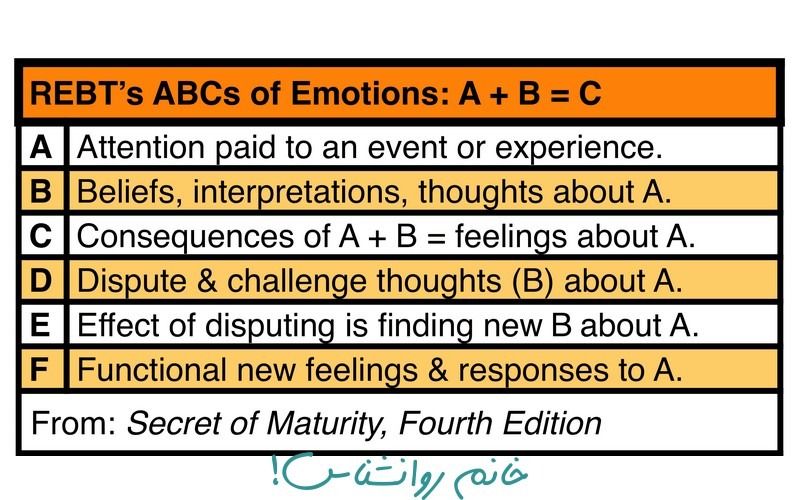
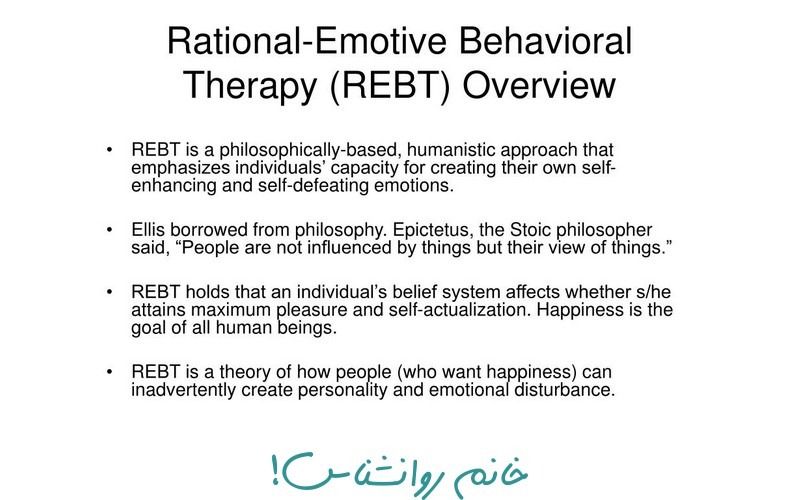
This philosophy is the most important part of REBT, so read it carefully. REBT holds that people have free will and are capable of reason; that they see the bigger picture, follow rules and can change; and that they are shaped by their beliefs. People are active but often out of balance, and the aim is to help them reach balance and growth. REBT is against dogmatism and is concerned with meaning. It assumes that we often do not know, and aims to help us know better, and it speaks directly.
REBT uses Socratic questioning, so the therapist needs to know which questions to ask. Its central idea is that it is not events themselves that make us happy or unhappy; it is how we think about them. So the focus should be on living life itself.
A note from behaviourism: shaping behaviour
In operant conditioning, behaviour is shaped by its consequences. Whenever we use praise or the promise of a reward, we are using operant principles.
Shaping matters: we reinforce each behaviour that moves towards the goal. Do not make empty promises, and keep promises and actions consistent.
For example, if we want our child to greet older relatives, we reinforce each small step the child takes towards them, rather than making promises we will not keep. Little by little the behaviour becomes more specific.
Change should happen gradually rather than all at once (for example, helping a child stop swearing). In REBT, we give the right nudge and let the person come to the realisation themselves.
What else to know about REBT
As therapists, we wait and intervene so that behaviour can take a better shape.
Schedules of reinforcement
1. Ratio schedules (based on the number of responses)
2. Interval schedules (based on time)
3. Combinations of the two
Any one-sided, dogmatic thinking tends towards control. (Over a lifetime, people are controlled bit by bit: as children they are frightened with stories of thieves, and later with other pressures.)
We should notice how many unrealistic beliefs we have mistakenly made precious to ourselves, wrapping them in layers of value. In REBT we gradually peel these layers back and gently challenge what the person treats as untouchable.
REBT holds that the purpose of a belief is to guide action. People are fallible (we will make mistakes), and judging is part of what the brain does, so "let's not judge" is not realistic; a better rule is "let's judge with as much information as possible, and at the right time".
Reaching people's beliefs is hard, because people hold on to their beliefs very tightly. Some ethical principles are universal; for example, therapists everywhere should behave in the same professional way and should not touch clients inappropriately.
We all hold beliefs that we take to be the truth, when they are really our view of reality; we need to distinguish between truth and our version of reality.
Beliefs should be questioned. For example: is yoghurt white? What is white? Is yoghurt white, or do we see it as white? REBT teaches us to question all our beliefs. At first we are sure yoghurt is white, but with the right questions a person may realise they cannot be entirely sure.
In REBT we aim to reach "maybe". We do not know everything, and we are always moving towards reality.
For example, why were stables once built next to houses? Partly because animals sense danger sooner than we do. Might we perceive the world differently if our senses were different? REBT invites us to think about questions like these.
One word stays constant in all of this: belief, because beliefs guide what we do.
REBT works with reality, and a flexible view of reality can save our lives.
Beliefs in REBT
Beliefs are covered by a layer based on our personal needs and survival, and by another layer of values. Freud's superego, which is emotional in nature, cannot be argued away. Many of our beliefs have no logic behind them, though they may be reasonable; for example, we follow a doctor's advice without asking for the reasons behind a prescription.
When we talk about beliefs, emotion is always involved.
Needs in REBT
Any real need that serves a useful purpose matters. We want people to feel good, so we should not take away someone's belief unless we can offer something to replace it. (In the therapy room we speak in the client's own language.) We cannot reach a person until we understand their beliefs.
What does "B" mean in REBT?
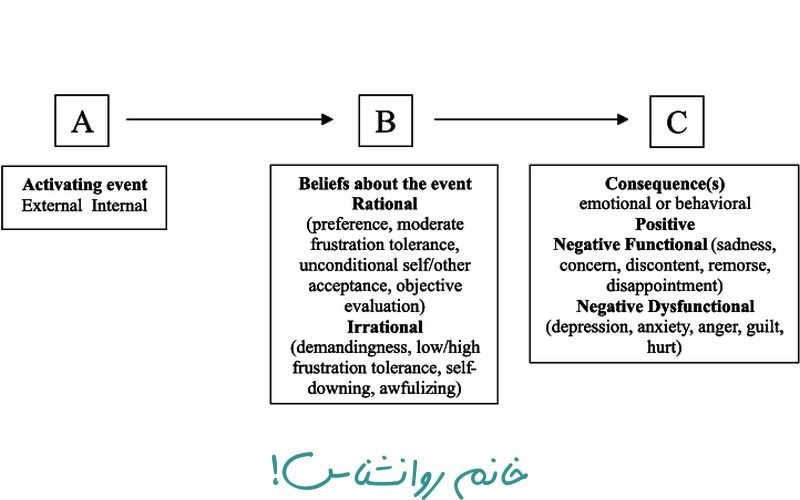
In Ellis's ABC model, A is the activating event, B is the belief about it, and C is the emotional and behavioural consequence. First, we need to know what a rational belief is.
A rational belief should be practical, testable against experience, functional and logical: all four.
A belief should be practical. For example, if two teenagers want to marry, we might ask the young man how he will support them. He may give an unrealistic answer: "I have some savings." What if you lose them? What if your friend won't lend you money? (This is a dream, not a practical plan.)
Based on experience: for example, when a married son or daughter went back to their parents' house after a quarrel, older generations often would not listen to just one side; they would say "come back together and we'll talk", because experience had taught them to.
Logical: some of our parents do not use smartphones. Are they wrong? Not necessarily; their logic is simply different from ours. So B stands for our beliefs, which shape our emotions and behaviour (C). Please look at the image.
What is a rational belief in REBT?
Rational beliefs matter in REBT: when something happens and a person's belief about it is rational, the consequences are healthy.
- A rational belief is flexible and not extreme.
- It fits reality.
- It is logical.
- It has helpful consequences and moves you forward.
- It serves your goals.
- It involves accepting yourself and others.
Types of rational beliefs
Non-dogmatic preferences: "expectation" and "preference" are important words; our lives should be based on our preferences rather than rigid demands.
We often have mature thinking but immature emotions, mainly because we were never taught how to let emotions mature. We need to let emotions pass through us.
The foundations of our thinking are closely tied to our emotions. So emotions need to be developed, and schools should pay attention to emotional learning; unfortunately, schools in Iran focus mainly on giving information. Because emotions are neglected, many of us grow up unable to manage them (think of road rage).
Rationality means a blend of logic and emotion; we need to let emotions pass through us, and emotion helps tell us what to learn. Feeling should be guided by logic.
No value should depend on a particular occasion; we need to fix the underlying issue. For example, "today is my birthday, so today I must be happy." People who think "this is a special occasion, so this must happen" often have little emotional richness in daily life. When our emotions are healthy, we stop catastrophising.
People with rational beliefs have higher frustration tolerance; they accept failure and do not see it as ruin or the end of everything.
Here is an example. A shopkeeper sees that his neighbour attracts many customers with small profits, but he does not want to work with small profits, so when a customer comes he overcharges them to make all his profit from one sale. Fairness, here, means small profits and high turnover. Bring this into your own life: fairness is showing love to the people you care about all the time, not only on special occasions.
A rational belief is flexible, expressed as a preference (not a "must"), does not catastrophise, and raises frustration tolerance. An irrational belief, by contrast, is rigid and absolute, and makes a catastrophe out of every event.
"Musturbation" in REBT
"Musturbation" is the term Ellis used for "must-thinking": turning wishes and preferences into rigid, absolute "musts". Ellis described three core "musts": "I must do well and win others' approval, or I am worthless"; "others must treat me fairly and well"; and "the world must be the way I want it, and life must not be hard". In REBT these "musts" are seen as the root of many unhealthy emotions, such as anxiety, depression and anger, and the aim of therapy is to turn them into flexible preferences, for example: "I would prefer to succeed, but if I don't, I am no less worthy."
What makes a good REBT therapist?
- Avoids fidgeting with parts of the body in ways that show anxiety.
- Preferably does not use a swivel chair.
- Avoids excessive movement.
- Presents neatly.
- Avoids heavy make-up.
- Sits at an angle to the client rather than directly opposite, so the client can look away.
- Sits neither too close nor too far (about 1.5 to 2 metres is good).
- Keeps tissues within the client's reach.
- Keeps the clock where the therapist, not the client, can see it.
- Does not sit behind a desk.