
Learning theories in psychology: the main approaches
Learning has many definitions, but there is broad agreement that learning is a relatively lasting change in behaviour that comes from experience. Learning is also shaped by biological, cultural, social and emotional factors.
Psychology has several theories to explain how people learn. The most important are:
- Behavioural learning theory
- Cognitive learning theory
- Constructivist learning theory
- Social learning theory
- Experiential learning theory
In this article I look at each of these theories. It is written for psychology students, parents, practitioners and anyone interested in the psychology of learning.
Behavioural learning theories
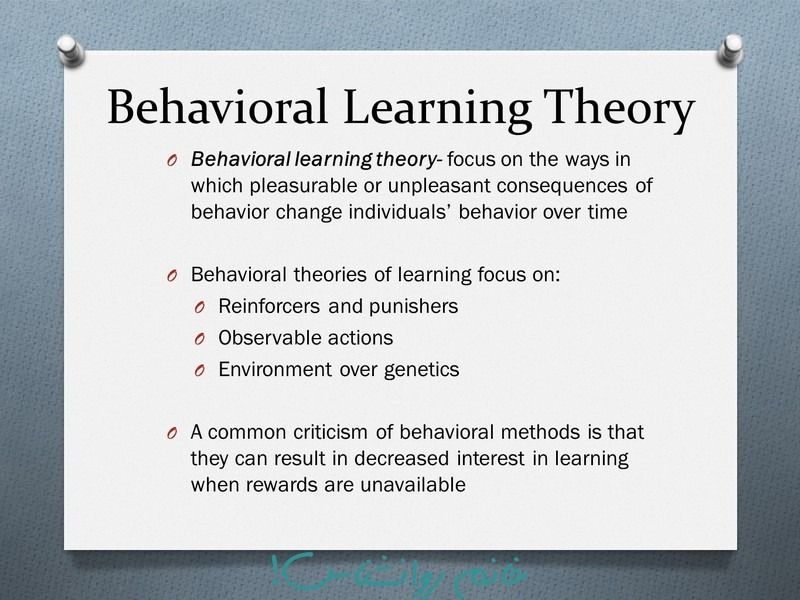
In the early twentieth century, many psychologists tried harder and harder to make psychology more scientific. These psychologists, whom we now call behaviourists, argued that psychology should study only what can be observed and measured.
Several behavioural theories emerged to explain how and why people behave as they do. Behavioural theories focus on environmental influences on learning: associations, reinforcement and punishment.
Learning through association
Classical conditioning shows that learning happens when an association forms between a previously neutral stimulus and a naturally occurring stimulus. In experiments by the Russian physiologist Ivan Pavlov, a natural stimulus (food) was paired with a sound. Dogs naturally salivate in response to food, but after many pairings they salivated at the sound alone: they had been conditioned to associate the sound with the arrival of food. This is the famous example through which most of us first learn about classical conditioning.
In classical conditioning:
- learning happens by forming associations between natural stimuli and a previously neutral stimulus;
- the neutral stimulus must come just before the natural stimulus;
- the focus is on automatic, natural behaviours.
Learning through reinforcement
Operant conditioning is a type of associative learning in which a behaviour is strengthened or weakened by reinforcement or punishment. What does that mean?
Operant conditioning was first described by the behavioural psychologist B. F. Skinner, so it is sometimes called Skinnerian conditioning or instrumental conditioning. Skinner believed that classical conditioning could not explain every kind of learning, and he was more interested in how the consequences of actions influence behaviour.
Like classical conditioning, operant conditioning relies on forming associations. In operant conditioning, however, the association is between a behaviour and its consequences.
In operant conditioning:
- learning happens when behaviours are followed by reinforcement or punishment;
- consequences need to follow the behaviour quickly;
- the focus is on voluntary behaviours.
So when a behaviour leads to a desirable outcome, it becomes more likely to happen again. When it leads to a negative outcome, it becomes less likely.
Cognitive learning theories
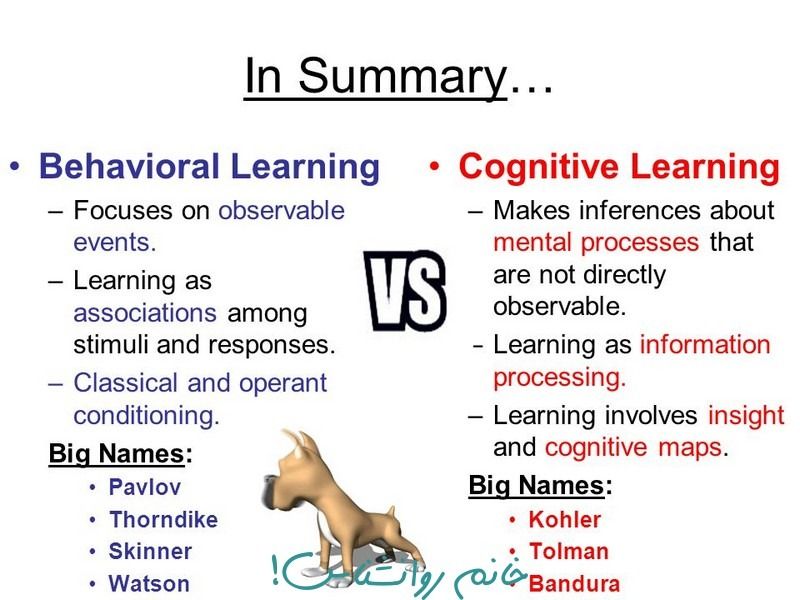
Cognitive learning theories focus on how cognition, attention, memory and information processing help us gain knowledge. One of the best known is Jean Piaget's theory of cognitive development, which describes four stages of intellectual development in childhood.
These four stages explain how children learn about the world and process information:
- Sensorimotor stage: children learn about the world mainly through their senses and movement.
- Preoperational stage: marked by the development of language and learning through pretend play.
- Concrete operational stage: children begin to use logic, but still think about the world in very concrete terms.
- Formal operational stage: children begin to use deductive reasoning and can understand abstract and hypothetical ideas.
Constructivist learning theories
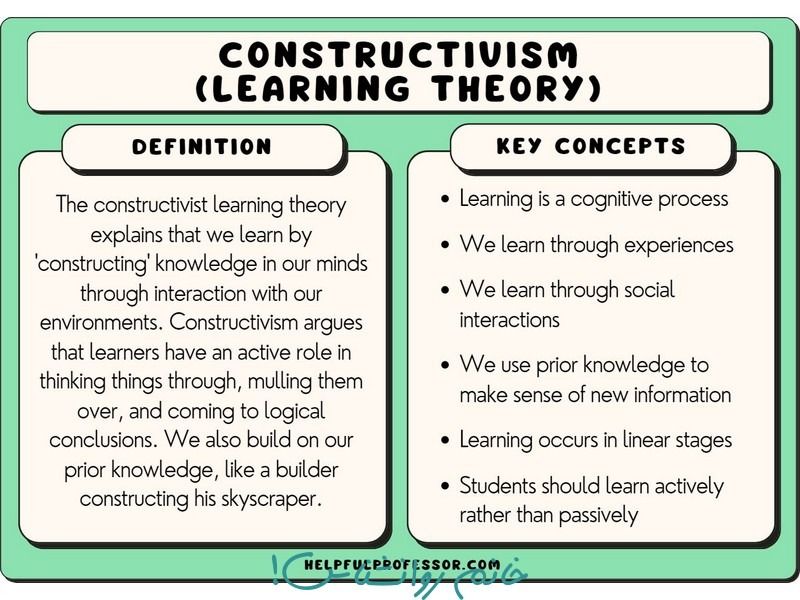
Constructivist theories describe learners as active participants who help build their own knowledge. They were influenced by the work of the psychologist Lev Vygotsky, whose sociocultural theory emphasised the importance of collaboration and social interaction in learning.
Two important ideas in constructivist theory are the "more knowledgeable other" and the "zone of proximal development":
- The more knowledgeable other: Vygotsky described this as anyone with a higher level of understanding or ability than the learner. It is often a teacher or another adult, but it can also be a peer, or even a particular tool or process.
- The zone of proximal development: the range of knowledge or skills a person can manage with help from a more knowledgeable other, but cannot yet manage on their own. Gradually expanding this zone is how people learn and improve their skills over time.
Social learning theories
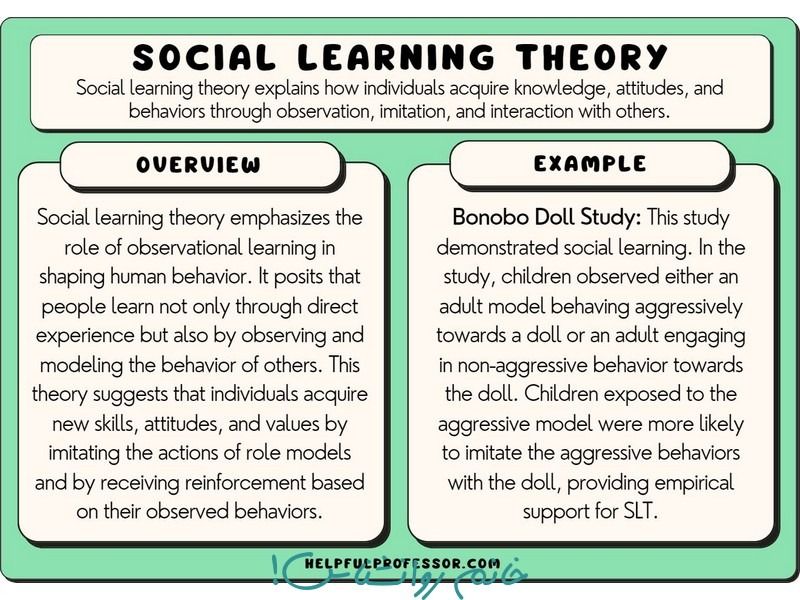
The psychologist Albert Bandura argued that much learning happens through observation. He believed that children watch the people around them, especially caregivers and siblings, and then imitate their behaviour.
In social learning:
- learning happens through observation;
- observation is happening all the time;
- the focus is on the interaction between social, cognitive and environmental influences.
In his famous Bobo doll experiment, Bandura showed how children can be led to imitate even aggressive actions. Children who watched an adult hit a large inflatable doll were more likely to copy those actions when they were given the chance.
Bandura also noted that learning something does not necessarily change behaviour. We often learn new things through observation but may not act on them until we have a need or a reason to use the information.
Experiential learning theories
Experiential learning theory focuses on learning through hands-on experience. It was formally set out by the psychologist David Kolb, and was influenced by other theorists including Jean Piaget and John Dewey.
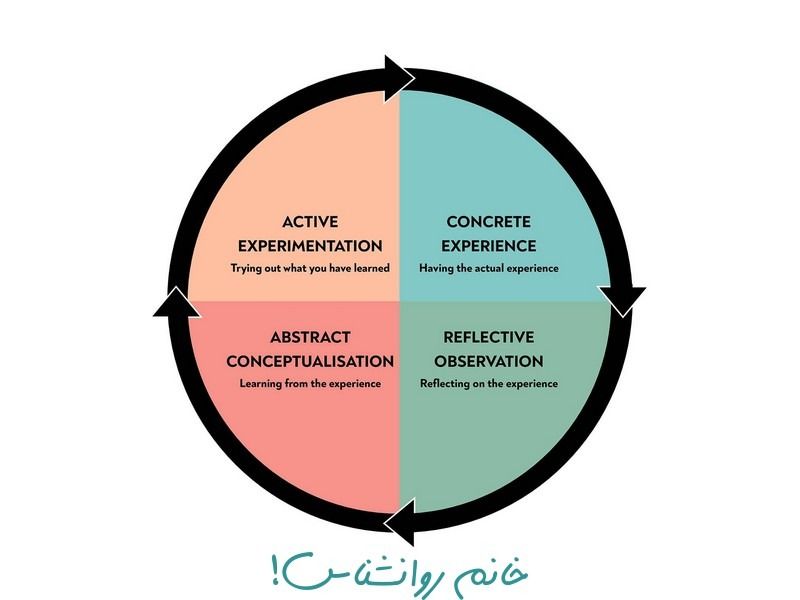
Kolb described experiential learning as a cycle of four stages: concrete experience, reflective observation, abstract conceptualisation and active experimentation. Concrete experience and abstract conceptualisation are about how we take in experience; reflective observation and active experimentation are about how we transform it into learning.
How learning theories are used today
These theories are not usually used on their own. Modern educators and psychologists draw on ideas from several of them to develop effective teaching strategies and psychological interventions that help people gain new skills and knowledge.
For example, although behavioural approaches no longer dominate as they once did, they still play an important part in education and therapy. Teachers continue to use behavioural strategies such as positive reinforcement and token economies to help shape learning.
Understanding these theories helps us tailor teaching and therapy to each person's needs.
Summary
Behavioural, cognitive, constructivist, social and experiential theories are among the best-known and most influential theories in psychology. They have shaped approaches to education, therapy and parenting.
Every learner is different, so combining approaches, such as behavioural, constructivist and experiential strategies, can help make the most of learning opportunities and improve outcomes.
Main source: Verywell Mind.