
Understanding children's and teenagers' drawings
Interpreting children's and teenagers' drawings is a fascinating subject at the meeting point of art and psychology. Because drawing plays such an important part in children's artistic and psychological development, it is worth understanding.
Drawing is not only a creative way for children and teenagers to express thoughts and feelings; it also helps develop their artistic and cognitive skills. Through drawing and colouring, children can express their own thoughts and experiences. Drawing can also be a way to understand children's thinking and emotional world a little more deeply.
Children's drawings can tell you a lot about their fears, joys, dreams, hopes and nightmares, and they can give you a valuable window into who your child is.
Children start drawing as soon as they are old enough to hold a crayon or pencil and put it to paper. For little ones, drawing is a natural and usually very enjoyable activity. They draw to express feelings because they do not yet know how to put many feelings into words. Through drawing they express their fears, joys, dreams, hopes and nightmares, and they also give you clues about their relationships with the world around them.
Drawing is a way of communicating, and children's artwork reflects their personality. Every child's drawings are unique and can tell us something about the young artist.
Every parent hopes to find meaning in their child's drawings. Sometimes a drawing is just a drawing, nothing more than a fun moment on paper. At other times, looking closely at a drawing can reveal a deeper layer of what your child is thinking and feeling. So do not read too much into a drawing; instead, let your child tell you what it means to them. Asking questions, such as what the people in the picture are doing, can reveal things you might never notice yourself.
An important note before you read on: interpreting a child's drawing is not, on its own, a reliable diagnostic tool. Research has found that interpreting single signs, such as missing hands or small feet, has poor reliability and validity. Treat the ideas below only as a way to start a conversation with your child, not as conclusions about them. If you are worried about your child, talk to your GP or a child mental health professional.
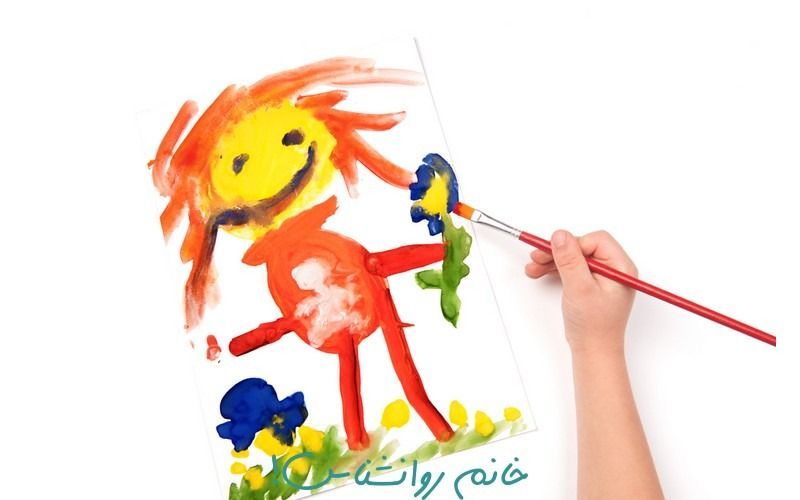
The stages of children's drawing
Children's drawing is often described in three early stages: scribbling, pre-schematic and schematic.
Scribbling (about 2–4 years)
At this stage there is no realism in the pictures; they are mostly marks on a page. It may look as if there is nothing there, but sometimes children create what is called "fortuitous realism": when the scribbling is finished, you may be able to see particular shapes, such as something that looks like a car or a house.
Pre-schematic stage (about 4–7 years)
At this stage children try to draw things they see. They may draw the simplest things, such as faces, stick figures, cars, trucks, trees and houses, usually without realistic detail. Towards the end of this stage they start adding details that make their ideas distinct, such as flowers in front of a house or clothes on stick figures.
Schematic stage (about 7 years and older)
At this stage children develop a "schema", a set way of showing things. For example, a drawing of the beach might include seagulls, starfish, a beach ball and people in swimsuits. Words and symbols may be added to give more information about the picture. Human figures have more detail, such as freckles. There is more depth and realism, and new perspectives become possible.
Gender and colour preferences in children's drawings
Some studies have found differences in what and how girls and boys tend to draw. Girls more often draw rounded shapes such as flowers and hearts, while angles, boxes and straight lines are more common in boys' drawings, along with cars, buses and so on. These are general tendencies, not rules, and they are shaped by culture and by what children are encouraged to draw.
Some researchers have also reported that girls tend to use more colours in each drawing than boys, and to prefer warmer colours (such as pink), while boys lean towards cooler colours (such as blue).
Popular guides often give colours particular meanings. These ideas are not backed by solid research, so take them lightly:
- Black and purple are said to suggest dominance, and may be favoured by a fairly demanding child. Blue is said to be popular with caring children who enjoy company.
- Red is the colour of excitement, perhaps used so as not to miss out on anything, and is one of the most popular colours with children.
- Pink is said to show a need for love and appreciation.
- Green is said to belong to children who like to be different, like space, and are artistic and bright.
- Yellow is said to suggest intelligence and a sunny nature.
Where on the page?
In traditional interpretations, the left side of the page is linked with the past and with nurture, and with mothers.
The right side is linked with interest in the future and the need to communicate, and with fathers.
A child who places a good-sized drawing prominently on the page is often seen as balanced and secure, while small figures drawn along the bottom edge or tucked into a corner are sometimes read as signs of feeling inadequate or insecure.
What feelings can children's drawings show?
You may pick up many feelings from your child's drawings, but until your child has a chance to explain them, you may also miss much of what they mean. Still, some features have been suggested as possible clues to a child's feelings.
Very precise, detailed drawings may suggest a child who puts a lot of effort into getting things right.
Heavy strokes, especially when close together, may be a sign of stress, strong feelings, determination or anger, while lighter marks may suggest a gentler nature.
The quality of the line may also be meaningful. A figure drawn with faint, shaky or broken lines is sometimes read as a hesitant, insecure child who seems to think as they go, while a bold, continuous, freely drawn line is read as confidence and a sense of security.
When children draw figures, size and relative size are seen as important, with important or dominant figures drawn larger.
Missing arms are sometimes interpreted as timidity, a sign of a non-aggressive child, while exaggerated hands are sometimes seen as a sign of aggressive tendencies if the figure is a self-portrait. In the same way, small feet are sometimes taken as a sign of insecurity: literally an unsteady foundation. Remember the caution above: single signs like these are not reliable on their own.
Popular guides also list features such as these:
- An impulsive child: large figures, no neck, uneven limbs.
- An anxious child: clouds, rain, flying birds, faces without eyes.
- A shy child: short figures, no nose or mouth, tiny figures with arms close to the body.
- An angry child: large hands and teeth, long arms, crossed eyes.
- An insecure child: monsters, tiny heads, no hands, slanted figures.
How to encourage children to draw
Learning to look at your child's drawings with curiosity can be very useful for parents. Even so, encourage drawing above all as a creative, enjoyable activity.
Art experiences help children develop independence within safe limits, and give them the chance to represent their ideas on paper or in other forms. Most importantly, creative expression lets children tap into the magic of their imagination, which is what being a child is all about.
Here are some things you can do to encourage your child to draw more:
- Make art a regular part of playtime.
- Offer a variety of materials, such as crayons, thick pencils and washable markers.
- Cut open paper bags to draw on and make it fun.
- For young children, tape the paper to the table so it does not move while they draw.
- Instructions are not needed. Let your child experiment, explore and express their creativity in their own way, so they feel confident, capable and clever.
- Pay attention to the process, not just the product. Rather than only praising the result, join in: help them draw something more complex, or choose colours together for a treehouse.
- Use art to help your child express strong feelings. If your child feels angry, help them draw a very angry picture to let those feelings out.
- Display your child's art and writing, so they know their work is valued and important.