
Choice theory: William Glasser's theory explained
Choice theory rests on a simple principle: each of us can only control ourselves, and we have very limited power to control anyone else. Used well, choice theory helps people take responsibility for their own lives and stop trying to direct other people's decisions and lives. It encourages people to own their choices and to support others in owning theirs. The result is less negative behaviour, stronger relationships and greater satisfaction with life. In this article I explain the theory in more detail: by the end you will know what it is, how to apply it, who created it and what his best-known book says.
What is choice theory?
Choice theory was developed by the American psychiatrist Dr William Glasser. It emphasises each person's control over their own actions and thoughts. Conflict arises because we can only control our own behaviour. Glasser's choice theory teaches that all behaviour is chosen, and that all human behaviour is driven by the wish to meet five basic needs:
- Love and belonging
- Power
- Freedom
- Fun
- Survival
I return to these needs below. According to choice theory, everything we do is an attempt to meet one or more of these five needs. As our self-control grows, we can make better and more responsible choices, and choice theory recommends using seven "caring" or connecting habits in all our relationships:
- Supporting
- Encouraging
- Listening
- Accepting
- Trusting
- Respecting
- Negotiating differences
On the other side, Glasser described seven "deadly habits" that we use to try to control others. In the end they damage relationships and lead to misunderstanding and resentment:
- Criticising
- Blaming
- Complaining
- Nagging
- Threatening
- Punishing
- Bribing or rewarding to control
In every relationship, each of us chooses whether to use connecting habits or disconnecting ones.
The ten axioms of choice theory
Choice theory is built on ten axioms, or core principles:
- The only person whose behaviour we can control is our own.
- All we can give another person, or receive from them, is information.
- All long-lasting psychological problems are relationship problems.
- The problem relationship is always part of our present life.
- What happened in the past has everything to do with who we are today, but revisiting a painful past contributes little or nothing to what we need to do now: improve an important present relationship.
- We are driven by five genetic needs: survival, love and belonging, power, freedom and fun.
- We can only satisfy these needs by satisfying the pictures in our quality world.
- All we do from birth to death is behave, and all behaviour is "total behaviour", made up of four components: acting, thinking, feeling and physiology.
- All total behaviour is described with verbs and named by its most obvious part; for example, "depressing" rather than "being depressed".
- All total behaviour is chosen, but we only have direct control over acting and thinking. We change our feelings and physiology indirectly, through how we choose to act and think.
The quality world in choice theory
Glasser's ideas place great weight on the "quality world", so it is worth understanding the term. The quality world is a space in the mind where we store specific pictures of what matters most to us: places, things, beliefs and people.
Glasser believed that the pictures in our quality world feel good and meet at least one basic need. They do not have to match society's standards; they are unique to each person, and our idea of an ideal life lives in this quality world.
The perceived world in choice theory
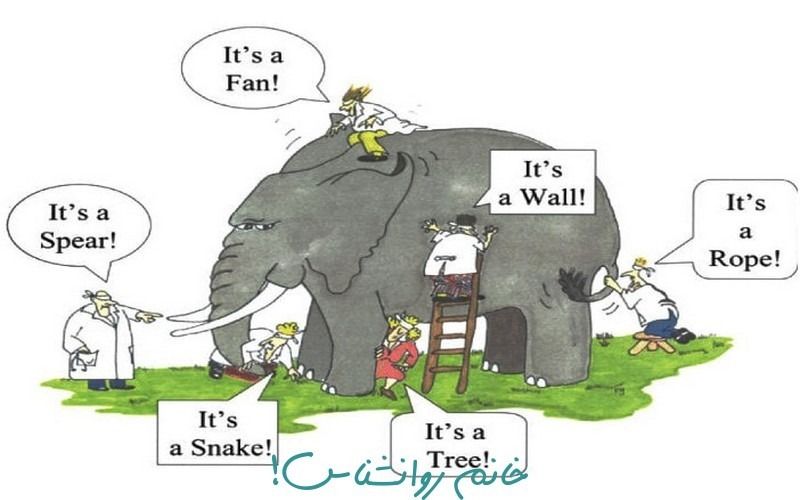
Choice theory says that we experience the real world through our perceptions. We gather information through our five senses and then pass it through our total knowledge filter.
The total knowledge filter
The total knowledge filter is made up of everything we have experienced in our lives. When we meet new information, we have to make a decision. We can:
- ignore the information;
- believe it may be meaningful but needs further examination; or
- decide that it is meaningful and pass it through our valuing filter.
Information that passes through the valuing filter is given a value:
- pleasurable information has a positive value;
- painful information has a negative value;
- information in between is treated as neutral.
This process is very personal, and our views can differ sharply from those of the people around us. Glasser believed that our perceived world is what we take to be reality. Our perceived world:
- depends on many variables, including gender, age, education and experience;
- is unique to each person;
- is always changing as we gather new information;
- is probably inaccurate (though in the moment it feels right).
Choice theory in practice
Helping people change what they do and think can change how they feel and how their body responds to stress. Education is a good example. Students who are unhappy because they cannot master certain concepts or skills can be helped to rethink what makes up their quality world.
As an article in Psychology Today notes, choice theory and reality therapy do not spend much time on the past. They ask clients to focus on the present (reality) and to imagine changes in their behaviour that would help them get what they want from life, or closer to the picture in their quality world.
Glasser developed the idea of total behaviour, made up of four elements: acting, thinking, feeling and physiology. People can only directly control how they act and think, but direct changes in actions and thoughts bring indirect changes in the other two.
Choice theory encourages people to build relationships in which they can share their quality worlds, creating cooperation and connection with others.
What is reality therapy?
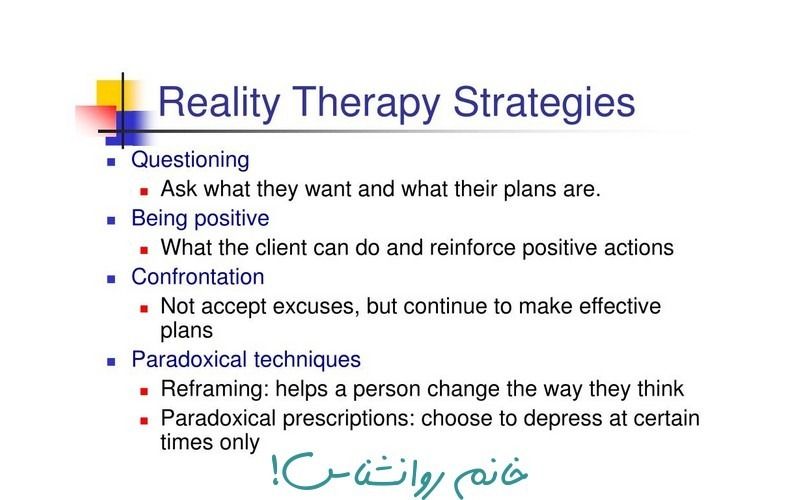
Reality therapy was built on the principles of choice theory. Its main goal is to help clients make more adaptive decisions that help them meet their basic human needs. Glasser did not accept the concept of mental illness in the usual sense; he believed that many problems come from not meeting our needs, and he saw much psychological distress as an expression of unhappiness. Because choice theory works in the present, the client is asked to focus on the here and now rather than reopen past experiences.
Reality therapy emphasises the relationship between client and therapist. The therapeutic relationship is seen as a model for the client's other relationships. In fact, Glasser believed that many psychological problems are relationship problems. The therapist's task is to guide the client towards choices that lead to better outcomes.
Reality therapy is a problem-solving approach. The client comes to see that their current behaviour is not working and needs to change, and to understand their own goals. A successful client learns to act responsibly and commits to more adaptive behaviour.
Reality therapy has been used for many problems, including addiction and other behavioural difficulties, and it has been especially popular in helping teenagers with behaviour problems at school and in the community. That said, the research on how well reality therapy works is more limited than for approaches such as CBT.
Internal versus external control psychology
One of the core ideas of choice theory is that all behaviour is purposeful. In other words, your behaviour is your best attempt in that moment, with the information you have, to meet your needs. Another way to say this is that all your behaviour is an attempt to make the real world match the pictures in your quality world.
Practising choice theory means understanding the choices you make to meet your needs, and honestly assessing whether those behaviours are really helping you get what you want. It involves a shift away from external control psychology, the belief that your experiences and behaviour are decided by outside forces such as luck, circumstances and other people.
Internal control psychology
Internal control psychology is the belief that you are responsible for your choices and their consequences.
Noticing the gap between what you want in your quality world and what you have in your perceived world motivates you to act. Practising choice theory gives you the knowledge and skills to let go of the myth of external control and use fewer disconnecting habits, becoming aware of your internal control and using connecting habits instead. This brings you closer to what you want in your quality world: better relationships and a better life.
William Glasser's book Choice Theory
Choice Theory: A New Psychology of Personal Freedom (1998) by William Glasser is a well-known book in psychology and personal development. Glasser, an American psychiatrist and author, developed choice theory from his beliefs about behaviour and personal decision-making. At its heart is a simple idea: each of us can only control part of our life, and because we make our own decisions, we need to take responsibility for them.
In the book, Glasser explains his theory and emphasises internal control and personal responsibility. He argues that all human behaviour is purposeful and results from decisions made to meet our needs and wants. To live a more positive and satisfying life, he suggests, we need to use our ability to control ourselves and take responsibility for our lives.
The book also covers ideas such as the quality world, the perceived world, and connecting and disconnecting habits, and encourages readers to use these principles to improve their relationships, strengthen internal control and reach their personal goals.
Summary
Everyone has many choices in life, even when it feels as if there are none. For example, a person under pressure to marry against their will may be able to get help from people they trust or from support services. (In Australia, forced marriage is a crime. In an emergency call 000; for advice, contact the Australian Federal Police on 131 237.) Having choices does not mean that every available choice is good or fair; the point is that everyone has some choice, and that a happier, calmer life does not come from trying to control others.
I do think the theory invites some criticism. In societies under dictatorship, many people's choices are taken away; should they still simply comply? Should they respect the dictator's choices? And what about genocide: do people really have a choice when even fleeing may not save them?
What do you think?